I also offer to you, woven into this journey, the terrain of my own mind and heart. My own life only occasionally makes an explicit appearance in the book, a little more in the course, but it is present in the guidance I bring to both. As I write in the book:
I am here as a father, and also as a six-year-old boy cracked open by the death of my own father. I am here as a husband of sixteen years, and as a man cracked open again with the end of that marriage. I am a child become a teenager, marked by periodic bursts of violence in the form of being bullied. And I am a teenager grown into an adult, carrying deep insecurities around masculinity and sex and being a very sensitive person. And I am that sensitive person, nourished by significant time spent with the stars and trees and rivers and animals, and by living and traveling widely throughout the world, and by just doing a lot of deep personal work.
Also woven into this book are my more explicitly professional experiences. The most obvious of these, in terms of what would appear on a resume, are my two decades of directing several nonprofits, and cofounding and living in two intentional communities dedicated to sustainability and justice. Nonprofits and intentional communities are both notoriously challenging, and I definitely experienced a lot of difficulty and heartbreak during those times, along with much success and joy.
Also present, though, are many experiences hidden behind those broad strokes, each with its own mix of accomplishments and shortfalls. For example, about fifteen years ago, while heading one of those nonprofits, I directed the creation of one of the greenest certified buildings in the US. Then, when nobody in the local area could even tell me which Native Americans’ homeland the building was located in, I researched that history, and I went to visit members of the Stockbridge-Munsee Band of Mohican Indians in Wisconsin, and I undertook projects to help raise awareness back in New York about them and their history. Then, when it came time for the nonprofit to sell the building, we directed the proceeds to the Mohican Language and Culture Committee as a way of supporting them and acknowledging their rightful stake in the land we had benefitted from and bought and sold.
To offer another example, in 2015, when corrections officers murdered a man, Sam Harrell, who was incarcerated in a prison mere minutes from my home (a young Black man with bipolar disorder, incarcerated for selling drugs), I dropped everything to help organize the local community and work with his family to seek justice for him, and to try to help prevent anything like that from happening again. We led protests, including a brief hunger strike by members of his family, we got national media coverage, and we met with more than twenty state representatives. We were successful in raising awareness about the need for prison reform, and we contributed to the passage of restrictions on the use of solitary confinement in New York State. But we had to live with the heartache and rage that nothing else at the prison changed, and not one of the officers involved in the murder was ever held accountable.
Some of my other professional experiences that inform my life and the journey of this book are: six years I spent launching an online education program for students to collaborate with Nobel Peace Prize laureates and others around the world to learn about current events and culture; five years where I participated in powerful dialogue work on “Race, Class, Gender and Power,” led by the incredibly skilled and visionary people at Be Present, Inc.; five years I gave to teaching Latin American literature in the Spanish bilingual program at Mission and Leadership High Schools in San Francisco; and a year working with community organizers in a shantytown in Venezuela (Barrio Bolivar) and evaluating environmental education programs throughout the country.
I strive to live simply but richly, in deep gratitude to the wonder and miracle of this world and life. I am mostly vegan, and I haven’t flown in a plane since 2021 due to the significant role (~5%) airplanes play in the unfolding climate disaster.


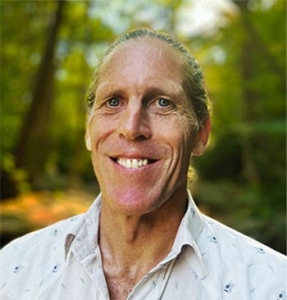 Jeff Golden, M.Ed., is the author of Reclaiming the Sacred, Healing Our Relationships with Ourselves and the World, named Best Environmental Book of 2023 by IndieReader, and winner of the Grand Prize at the Nautilus Book Awards (previous winners include the Dalai Lama, Brené Brown, and Barbara Kingsolver), among many other awards.